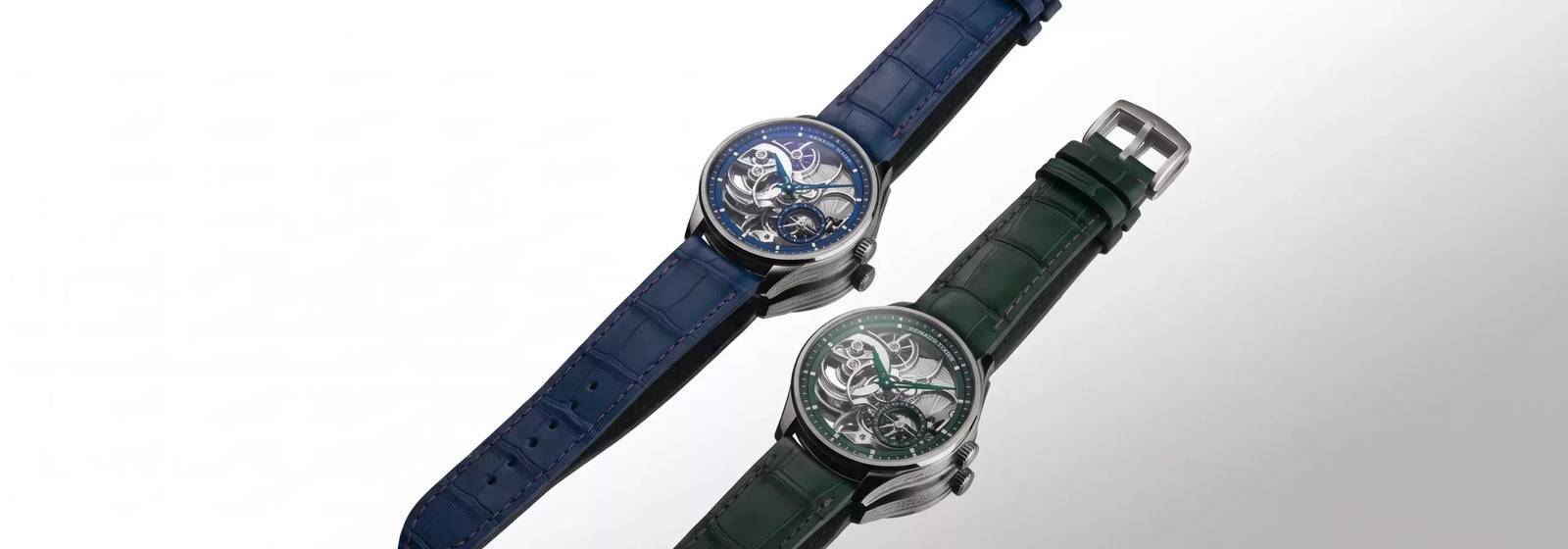
Skeletonisation is usually a treatment applied to a movement that was designed to be covered. The Renaud Tixier Monday Skeleton, announced on October 20, makes the opposite argument. The watch takes the young independent brand's first calibre, the micro-rotor automatic that launched the Monday in 2024, and rebuilds it as the fully openworked RVI2025: no dial in the conventional sense, stepped chapter rings where a dial would sit, and the entire mechanism, all 262 components of it, finished by hand and left in plain sight. It is offered in two editions of 15 pieces each, petrol blue and green, in an 18-carat grey gold case, priced at CHF 129,000 before taxes.
The Monday exists because of a winding problem. Micro-rotors are compact and elegant, but their small mass makes them indifferent winders. Dominique Renaud's answer, patented and nicknamed the dancer, places a spring-loaded platinum flywheel inside the platinum micro-rotor itself. As the rotor turns, it charges a propulsion spring coupled to that flywheel; when the rotor stalls, the stored energy is released back into the winding train, recovering motion that a conventional micro-rotor would waste. A declutching mechanism protects the calibre when a shock is detected. The idea draws on energy-recovery systems developed for the automotive world, rebuilt at watch scale. In the closed-dial Monday the mechanism was glimpsed through an aperture at nine o'clock. In the Skeleton it is simply there, part of the architecture a wearer reads all day.
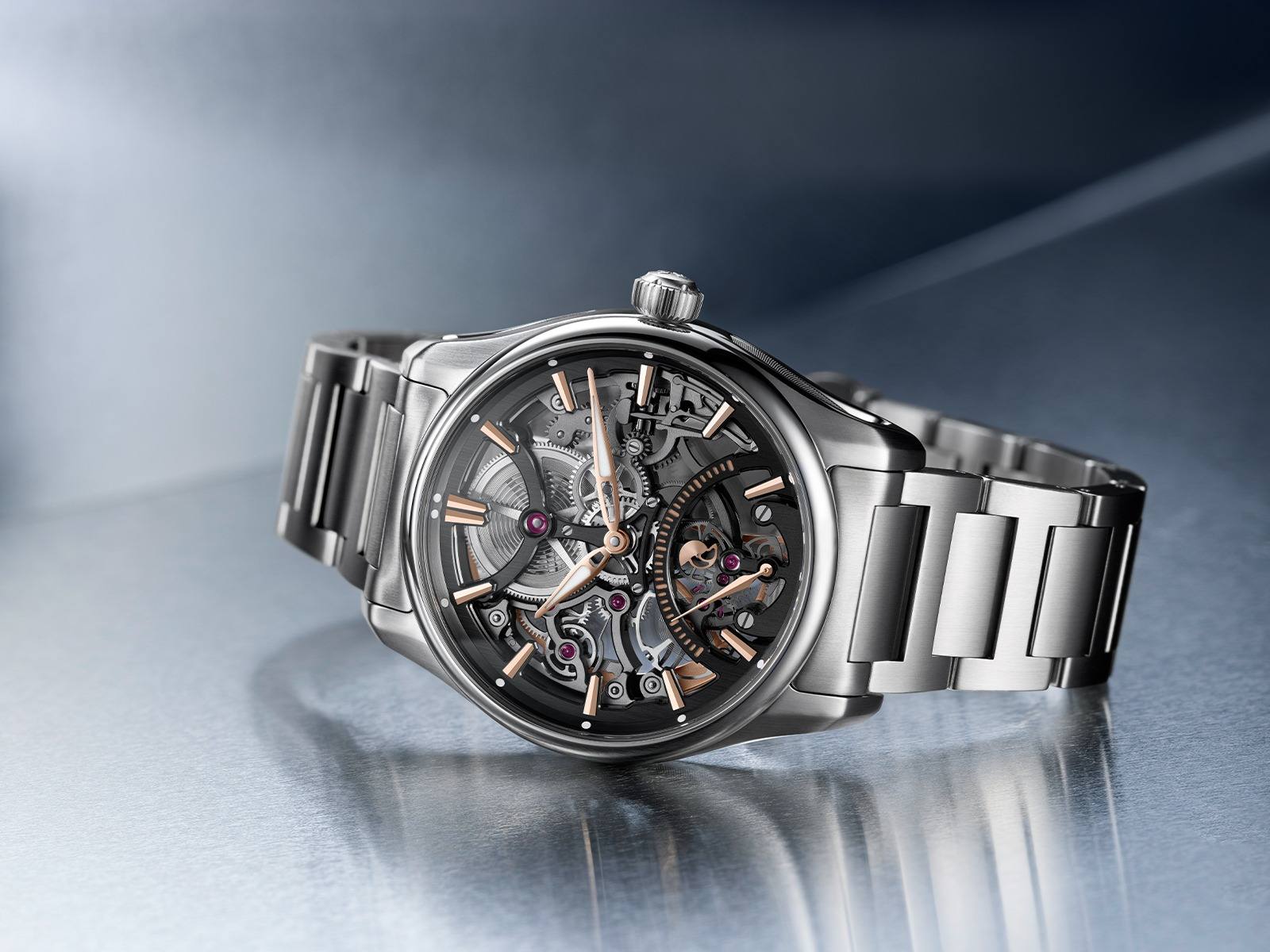
Turning the RVI2023 into the RVI2025 was not a matter of cutting holes. The original movement was never designed to be skeletonised, though its shaped, already openworked bridges hinted at the possibility. For the new calibre the bridges and structural elements were substantially reworked, and the plate over the barrel is now fully opened, framing the mainspring and its ratchet. That ratchet keeps the decoration given to the original Monday: a hand-engraved cover plate carrying a grand feu enamel plaque, colour-matched to the edition. The finishing list is the classical one, executed at the brand's workshops in Tolochenaz, between Geneva and Lausanne: black polishing, bevelling, bridge rounding, Cotes de Geneve, sunray finishing and circular graining. The number the brand leads with is 238, the count of inward angles in the movement, each cut and polished by hand. Inward angles are the detail that cannot be faked by machine, because a polishing wheel cannot reach into a sharp internal corner; only a file, a wooden peg and patience can.
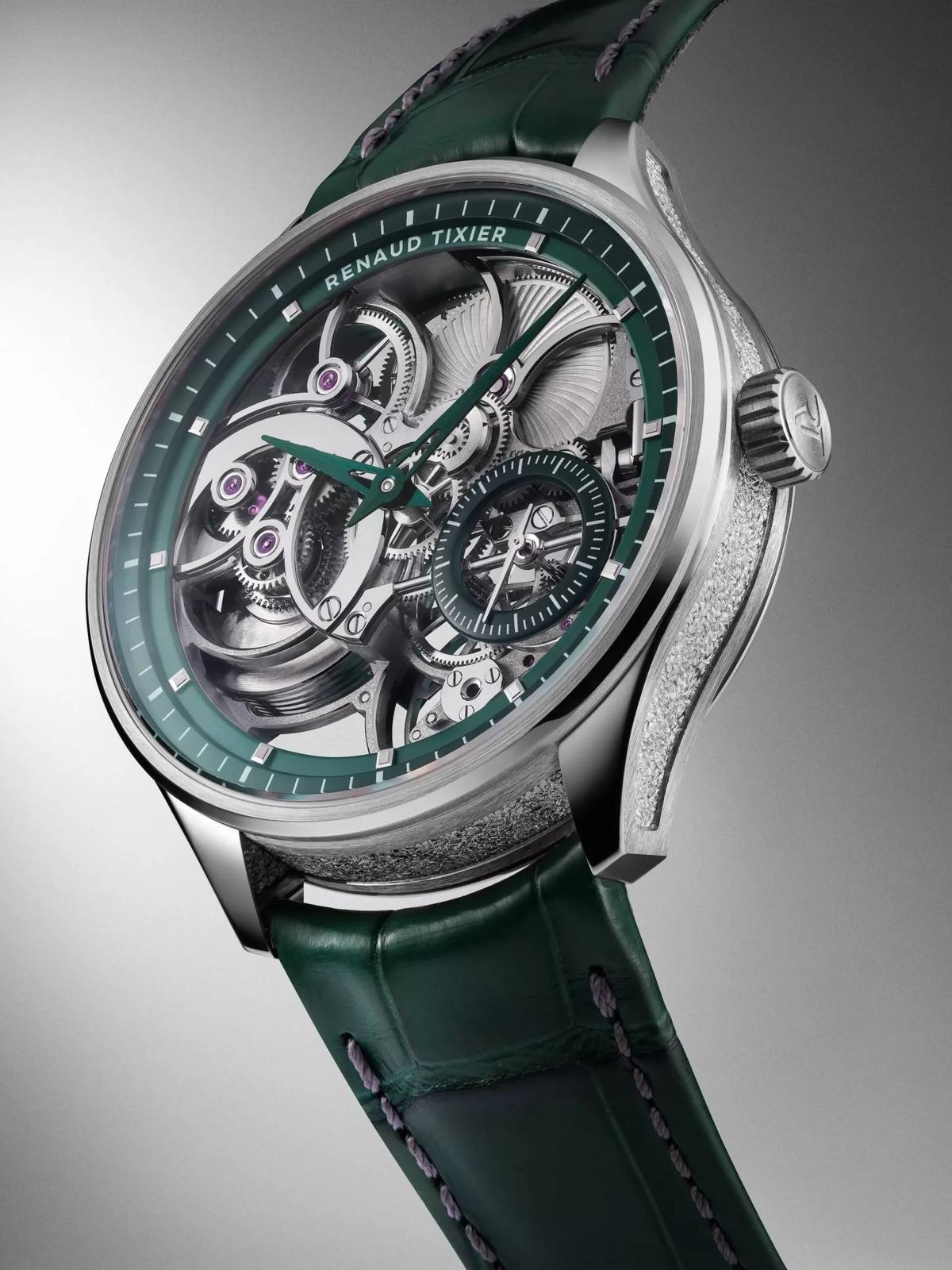
What remains of the dial is a set of stepped chapter rings for the hours and minutes and a linked small seconds counter, satin-finished in petrol blue or green. Skeletonised dauphine hands take the accent colour. Around them, a brushed rehaut carries faceted markers on its lower tier, with the minute track printed in white on the tier above, and the hand-stitched alligator strap repeats the colour. The case keeps the Monday's dimensions, 40.8 mm across and 12.6 mm high including the domed sapphire crystal. Its most labour-intensive surface is the one least often photographed: the caseband, and the metal between the lugs, are hand-engraved to an organic, frosted texture, while the bezel, the lug tops and the caseback ring are mirror polished against it.
The RVI2025 measures 36.8 mm in diameter and 6.83 mm in height, runs at 18,000 vibrations per hour (2.5 Hz), carries 29 jewels and holds a minimum power reserve of 72 hours. Water resistance is 30 metres. The caseback is open, and on the green example in the brand's photography the engraving reads 1 OF 15. These are small numbers even by independent standards: thirty watches in total across both editions.
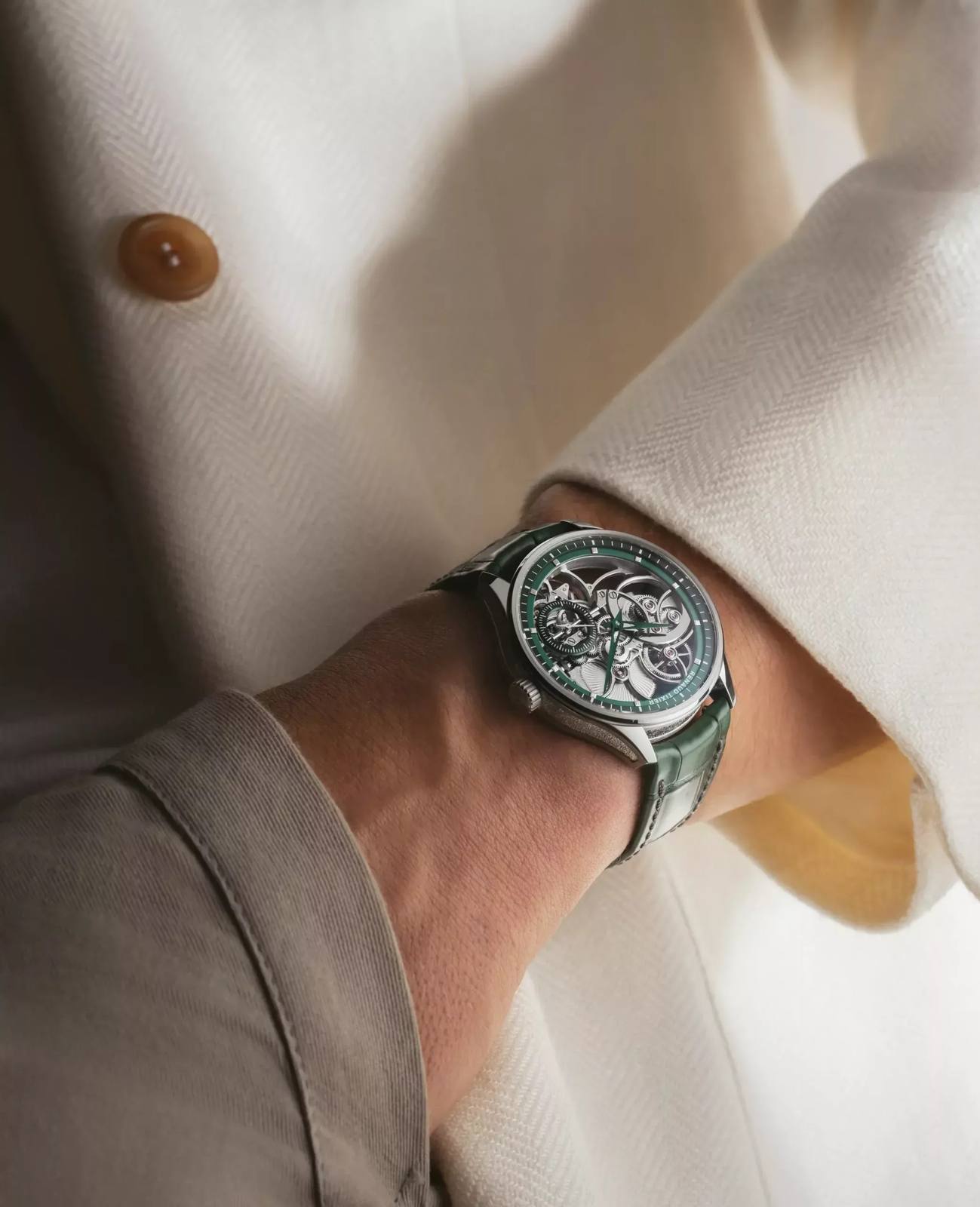
The Skeleton sits at the top of the Monday range. Launch reporting puts the standard Monday in grey gold from CHF 79,000, and the artisanal-dial Monday Organica at CHF 125,000 in rose gold, so the Skeleton's step of CHF 4,000 over the Organica is modest in context. What changes is where the money is spent. The Organica spends it on the dial surface, in engraving and enamel. The Skeleton spends it inside, on architecture and finish. Dominique Renaud began his career in a workshop devoted to skeleton watches, and Julien Tixier's reputation rests on finishing of exactly this kind, black polishing on titanium and inward angles by hand. Read that way, the Monday Skeleton is less a variant than a statement of method: the brand's first movement, shown with nowhere to hide.

Evaluated from the brand's specifications and launch reporting, the Skeleton makes a disciplined case. Skeleton watches often trade legibility and structural calm for spectacle. Here the stepped rings keep the time readable, the colour is confined to accents, and the movement stays the subject. Thirty pieces at CHF 129,000 before taxes will find their buyers quietly. The more durable point is what the watch demonstrates about the workshop behind it: a brand two years into its first model, willing to stake its reputation on 238 corners that most owners will need a loupe to appreciate.