Fifteen years after it launched the Legacy Machine line, MB&F has revived the watch that started it. The LM1 EVO, announced on October 13, takes the Legacy Machine N°1 of 2011, the brand’s first round-cased watch, and rebuilds it to the EVO specification that has since spread across the collection: a smaller and tougher case, screw-down crowns, 80 metres of water resistance, the patented FlexRing shock absorber, and an integrated rubber strap that is, for the first time on an MB&F, interchangeable. It arrives in two editions: grade 5 titanium, not limited, and rose gold, limited to 33 pieces.
The original LM1 was a deliberate swerve. After four years of Horological Machines shaped like spacecraft and engines, Maximilian Büsser asked what he might have made had he been born a century earlier, and answered with a round watch in the 19th-century manner: two lacquered time displays, classical numerals, and a vast 14 mm balance wheel floating above the dial beneath an arched bridge. The trade took the point. At the 2012 Grand Prix d’Horlogerie de Genève, the LM1 won both the Public Prize and the Best Men’s Watch prize. It stayed in the catalogue until 2017, when a final edition closed the run.
EVO began as a hardening programme. MB&F introduced the concept on the LM Perpetual, Stephen McDonnell’s perpetual calendar, and has since applied it to the Sequential chronographs and the LM101: cases built to be worn daily rather than kept for occasions, with screw-down crowns sealing an 80-metre depth rating, a FlexRing annular dampener fitted between case and movement to absorb shocks along the vertical and lateral axes, darker movement treatments, and rubber straps integrated into the case. The LM1 was the conspicuous holdout, the founding design still in its original, more delicate form. That gap is now closed.
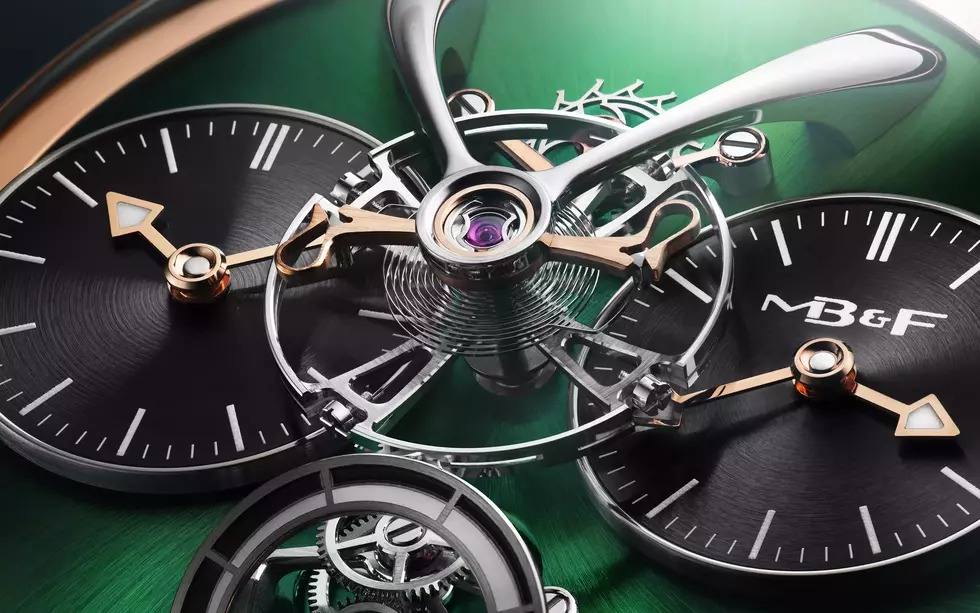
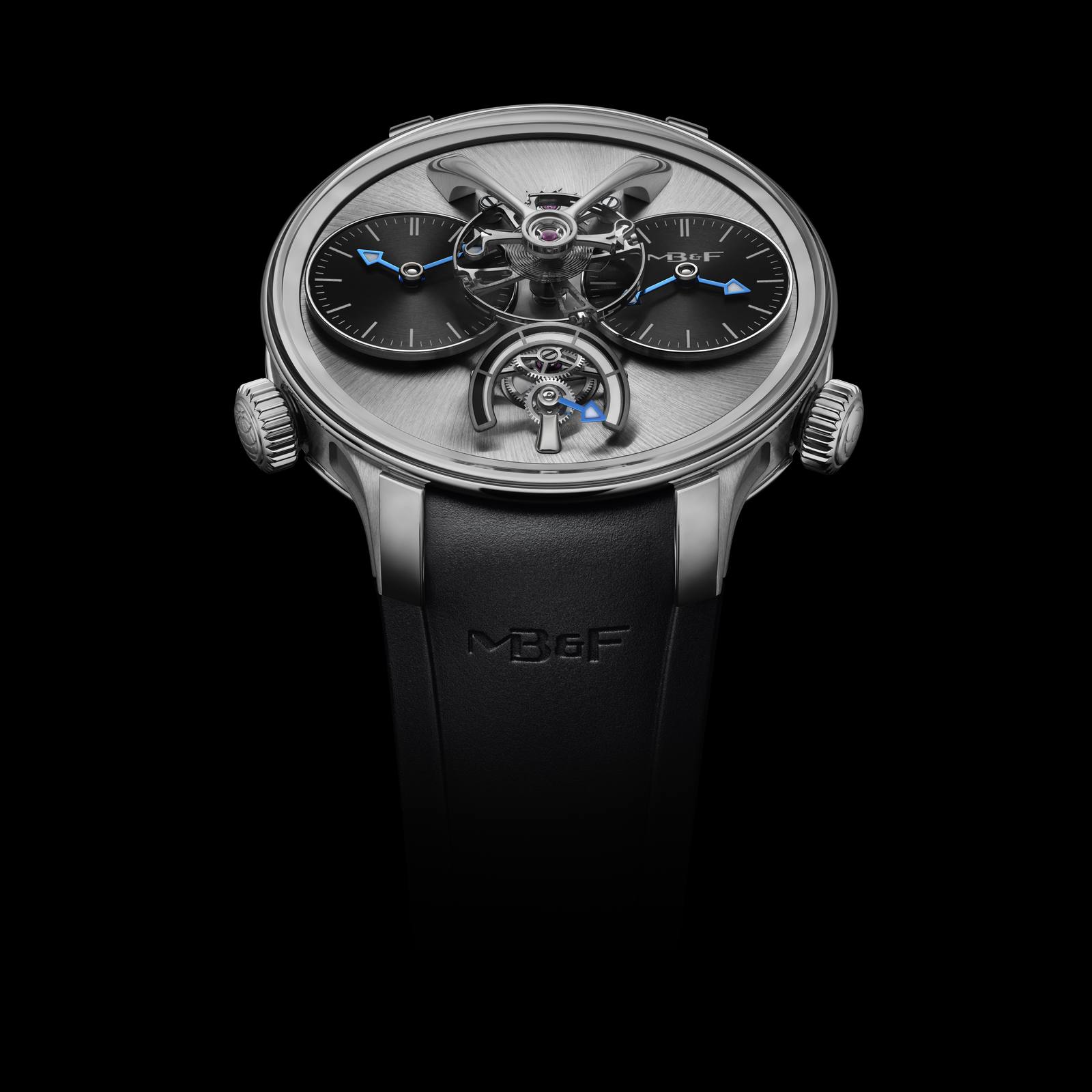
The case work is substantial. Diameter falls from the original’s 44 mm to 42 mm, a new size for the EVO line, with a 52 mm lug-to-lug measurement and a height of 16.8 mm that includes the high-domed sapphire crystal over the dial and a box sapphire at the back. There is no bezel in the conventional sense: the dome’s curve flows into the caseband, and MB&F bonds the glass directly into the metal with a thermal process it says adds structural strength and admits more light to the plate below. The titanium edition pairs a rhodium dial plate with black snailed subdials and blue arrow-tipped hands treated with luminescence. The rose gold edition sets the same black registers over a green plate with gold-toned hands.
What made the LM1 worth reviving is its approach to a second time zone. The two subdials are not a display and a slave: each shows its own hours and minutes, and each is set independently by its own crown, so the second display handles the half-hour and quarter-hour offsets used across much of Asia and Australia without approximation. MB&F also notes the further use the architecture allows: one dial can be run as an elapsed-time counter while the other keeps the time. None of that has been simplified for the EVO. The complication arrives intact.
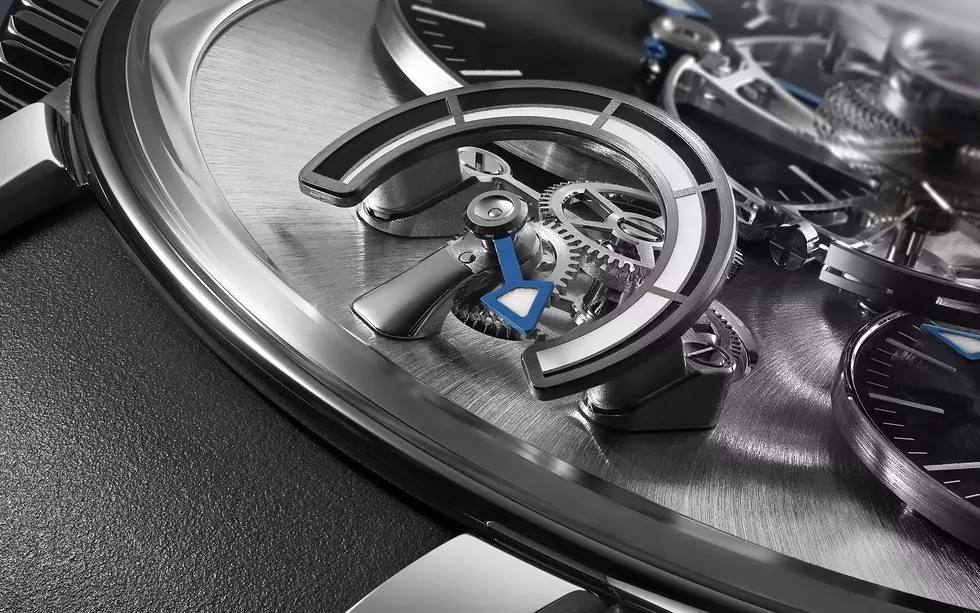
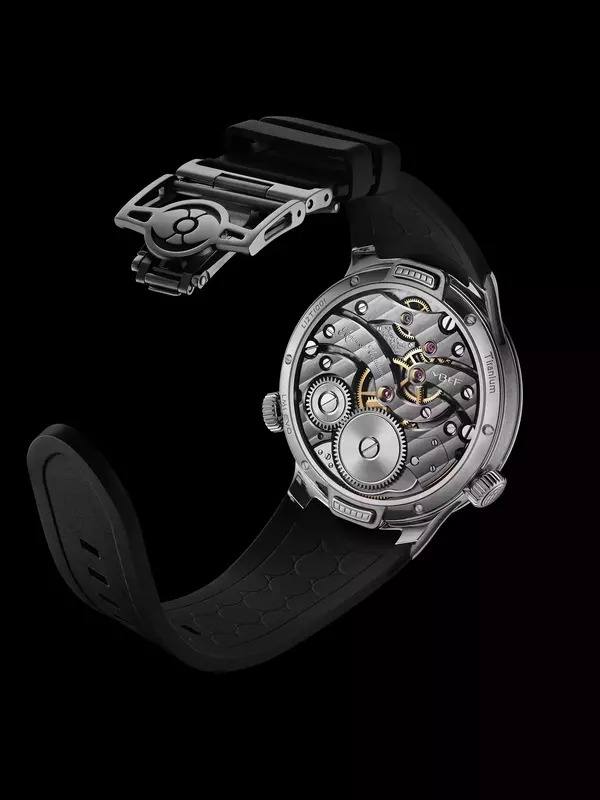
The movement, developed in-house with Jean-François Mojon to finishing specifications set by Kari Voutilainen, keeps the signature 14 mm balance wheel with four traditional regulating screws suspended above the movement, now working with a Straumann double hairspring in place of a single spring, and beating at the line’s traditional 18,000 vibrations per hour. The hand-wound calibre runs to 60 hours from a single slipping mainspring barrel, a third more than the original’s 45 hours, and the original’s theatrical vertical power-reserve indicator gives way to an inclined semi-circular gauge at 6 o’clock that MB&F judges easier to read at a glance. The finishing remains 19th-century in manner: gold chatons with polished countersinks, Geneva waves, polished bevels with internal angles, hand-made engravings, and black NAC bridges for the sportier EVO character.
The strap is a small first with practical weight. Integrated rubber straps are standard EVO equipment, but the LM1 EVO’s are interchangeable at both the case and the clasp through a quick-change system, so the black strap of the titanium watch or the grey strap of the rose gold can be swapped without tools. For a watch its maker is explicitly pitching at an active life, that matters more than another metre of depth rating.
Prices, excluding VAT, are CHF 82,000 (USD 109,000, EUR 89,000) for the titanium watch and CHF 102,000 (USD 137,000, EUR 111,000) for the rose gold edition of 33 pieces. Evaluated from the manufacturer’s specifications and launch reporting, the LM1 EVO reads less as a commemorative reissue than as a correction: the founding Legacy Machine, given the durability its maker has spent five years building into every sibling line. The 19th-century theatre is untouched. The watch around it has finally been built for the century it actually lives in.