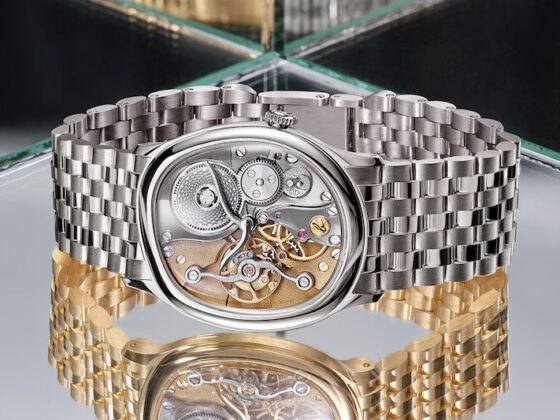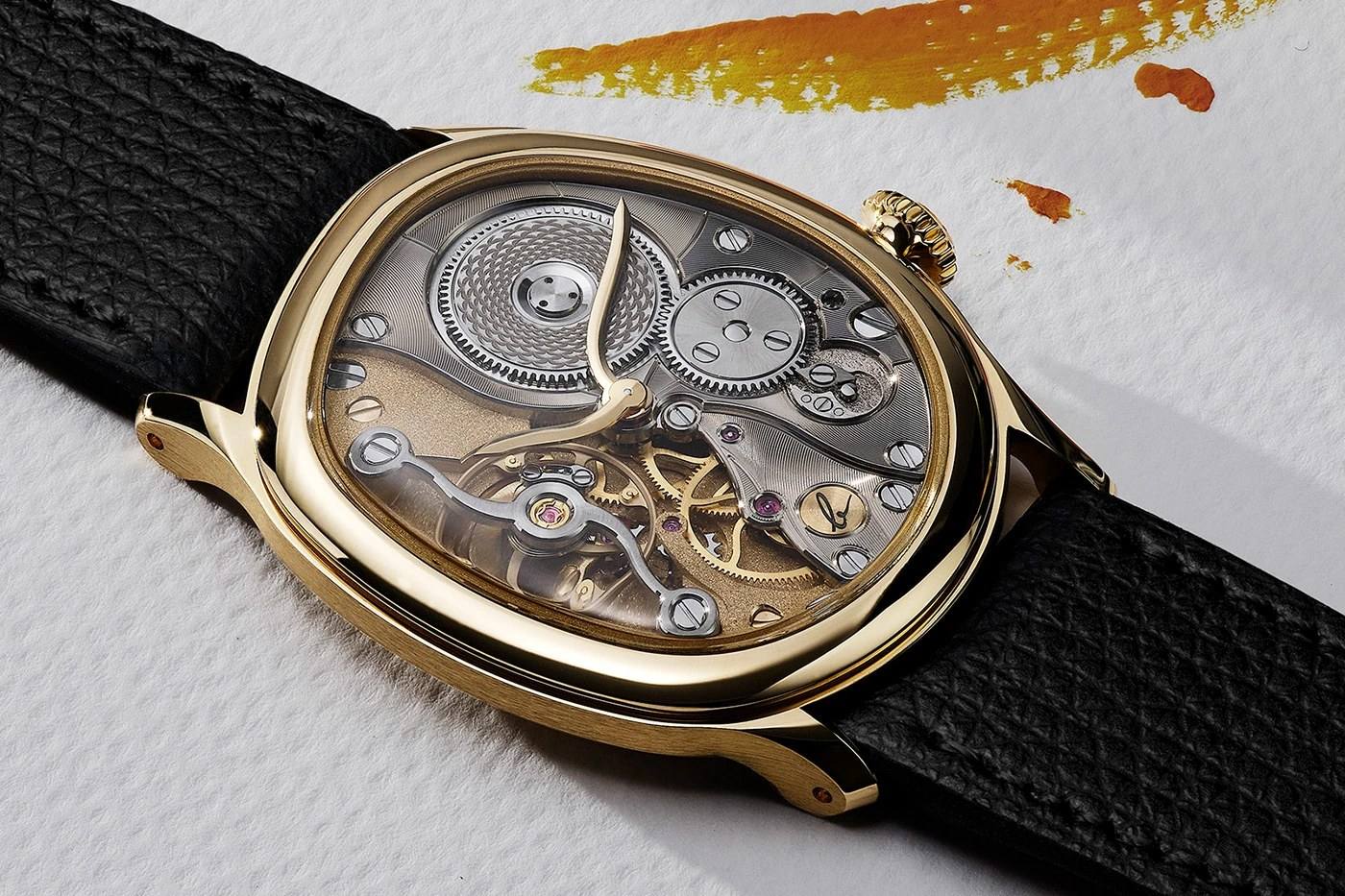
Sylvain Berneron builds movements the way an architect draws facades. The Mirage Miroir, shown at Geneva Watch Days 2026, is the fourth in-house calibre from the independent watchmaker, and it is his most radical to date. There is no dial in the conventional sense. The openworked plates and bridges of the calibre 283 have been mirrored, guilloched and finished as though they were the face of the watch, because they are. What you read the time from is not a hand against a chapter ring but the skeleton of a mechanism laid out like a building seen in elevation.
A mirror image, not a skeleton
The distinction matters. Most skeletonised watches begin as conventional movements that have been cut away, and however beautifully the cutting is done, the underlying architecture is still recognisable as the calibre it came from. The calibre 283 is related conceptually to the calibre 233 that powers the existing Mirage 38, but its architecture has been reconstructed as a mirror image rather than simply exposed or turned over. Because the gear train now runs in the opposite direction, the hands rotate correctly without the additional reversing wheels that a straightforward inversion would demand. The calibre measures 30 by 28 millimetres and just 2.83 millimetres thick, the dimension from which it takes its name, and the mirrored layout was drawn open from the start rather than arrived at by subtraction.
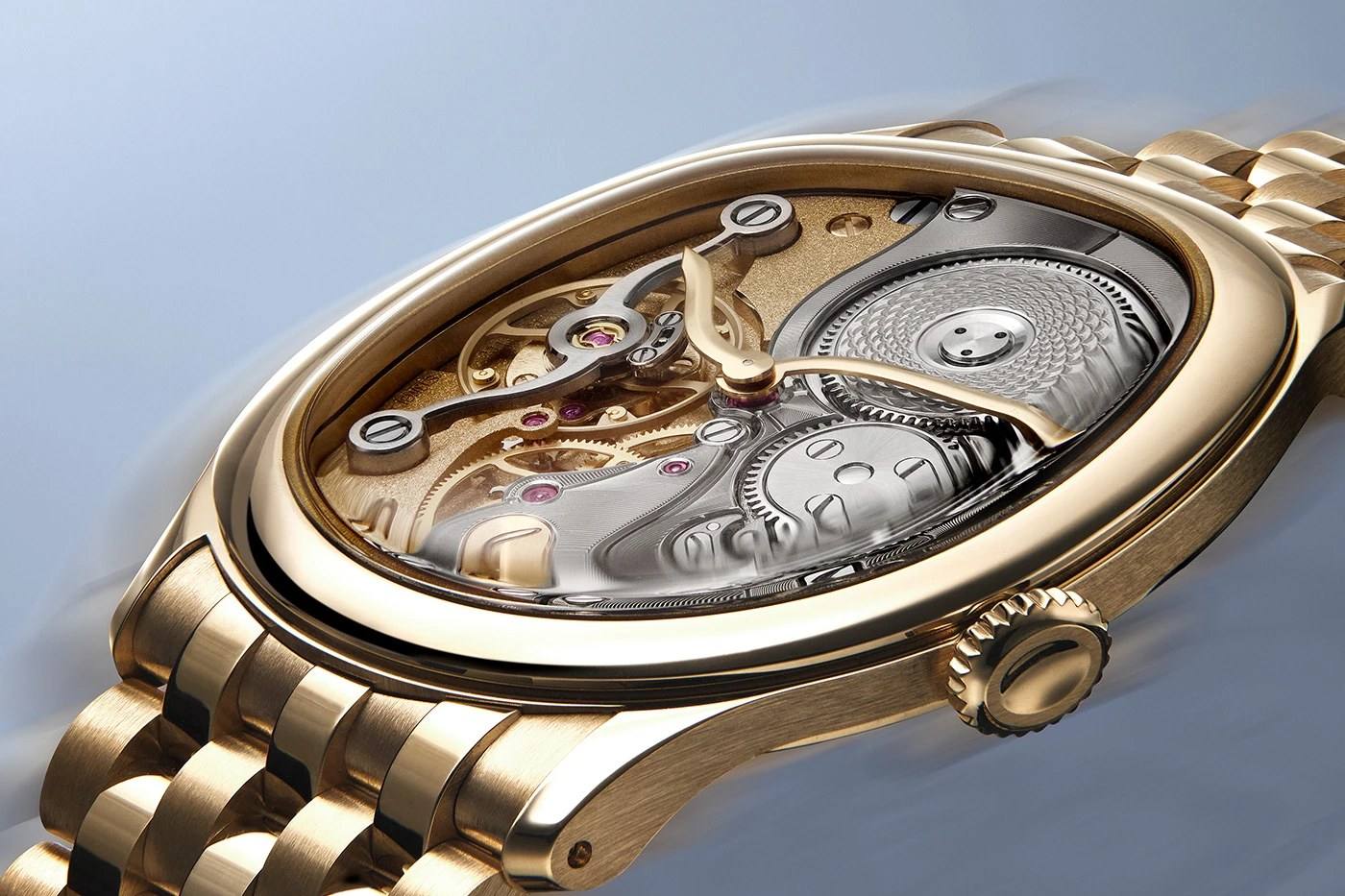
The mirrored construction reimagines openworking as a design language. The bridges and the mainplate have been conceived as visual markers that guide the eye across the movement, so the architecture reads like a dial even though nothing has been disguised. Sector-shaped guilloche patterns function as the hour references, set directly into the plates, while the asymmetric arrangement of the bridges leads the eye around the calibre instead of presenting a uniform field of exposed components. Decoration here participates in the interface: the guillochage is both ornament and information.
The inverted handset
To keep the calibre that thin, the handset is inverted. The hour hand sits above the minute hand, the reverse of the usual stacking, which frees space inside the movement and gives the shorter hand greater prominence against the mechanically busy background. There is no conventional seconds hand. A rotating seconds wheel is left visible within the architecture and acts as the running indicator, so the eye registers that the watch is alive from the motion of the calibre itself rather than from a sweeping hand. The specification reads like a dress movement stripped to its logic: 135 components, 17 jewels, a free-sprung balance beating at 21,600 vibrations per hour, and a 72-hour power reserve.

An all-gold movement
Precious metal runs deeper into the Miroir than its case. The calibre 283 uses 18K gold for its mainplate and bridges, continuing Berneron's unusually extensive use of gold inside the Mirage family, and the case, hands and even small hardware such as the spring bars are gold as well. Gold is not an automatic engineering upgrade: its softness demands care where components must hold dimensional precision and stable interfaces. The payoff is visual, since the exposed calibre lets frosted gold surfaces, polished bevels and guilloche interact directly with light instead of hiding behind a dial. The finishing vocabulary across the movement spans guillochage, anglage, snailing, laser engraving, concentric brushing, linear satin finishing and frosting, with hand craft and machine precision used side by side rather than treated as opposing camps.

Series A, from October 2027
The Mirage Miroir comes in the brand's asymmetrical 34mm Mirage case, 7mm thick, in 18K yellow or white gold, with a scratch-resistant-coated Hesalite crystal and 30 metres of water resistance. It is offered on a Barenia leather strap at CHF 72,500 excluding taxes, or on a seven-row solid-gold bracelet at CHF 130,250, roughly $89,528 and $160,842. The bracelet is a serious object in its own right: some 125 grams of 18K gold, with alternating satin and polished links, and it fits the existing 38mm Mirage Sienna and Prussian Blue cases as well as the Miroir. Production is deliberately slow. Launch coverage reports 36 pieces per metal a year across a decade-long Series A run, with the first deliveries expected in October 2027.
The Miroir is the logical endpoint of Berneron's approach to watchmaking, in which the finishing of a movement is not the final step but the first design decision. Most openworked watches are movements that lost their dials. The calibre 283 never had one to lose.