
Audemars Piguet opened November by returning to the complication it has spent a decade refining in public. On 2 November the manufacture added three Minute Repeater Supersonnerie references: two 42 mm Royal Oaks, in titanium and in pink gold, and a 41 mm Code 11.59 in white gold. All three are powered by the same hand-wound calibre 2953, and all three use the patented Supersonnerie acoustic construction, in which the repeater's gongs are mounted on a dedicated soundboard inside the case rather than fixed to the case itself, a design intended to give the strike more volume and clarity than a conventional repeater case allows.
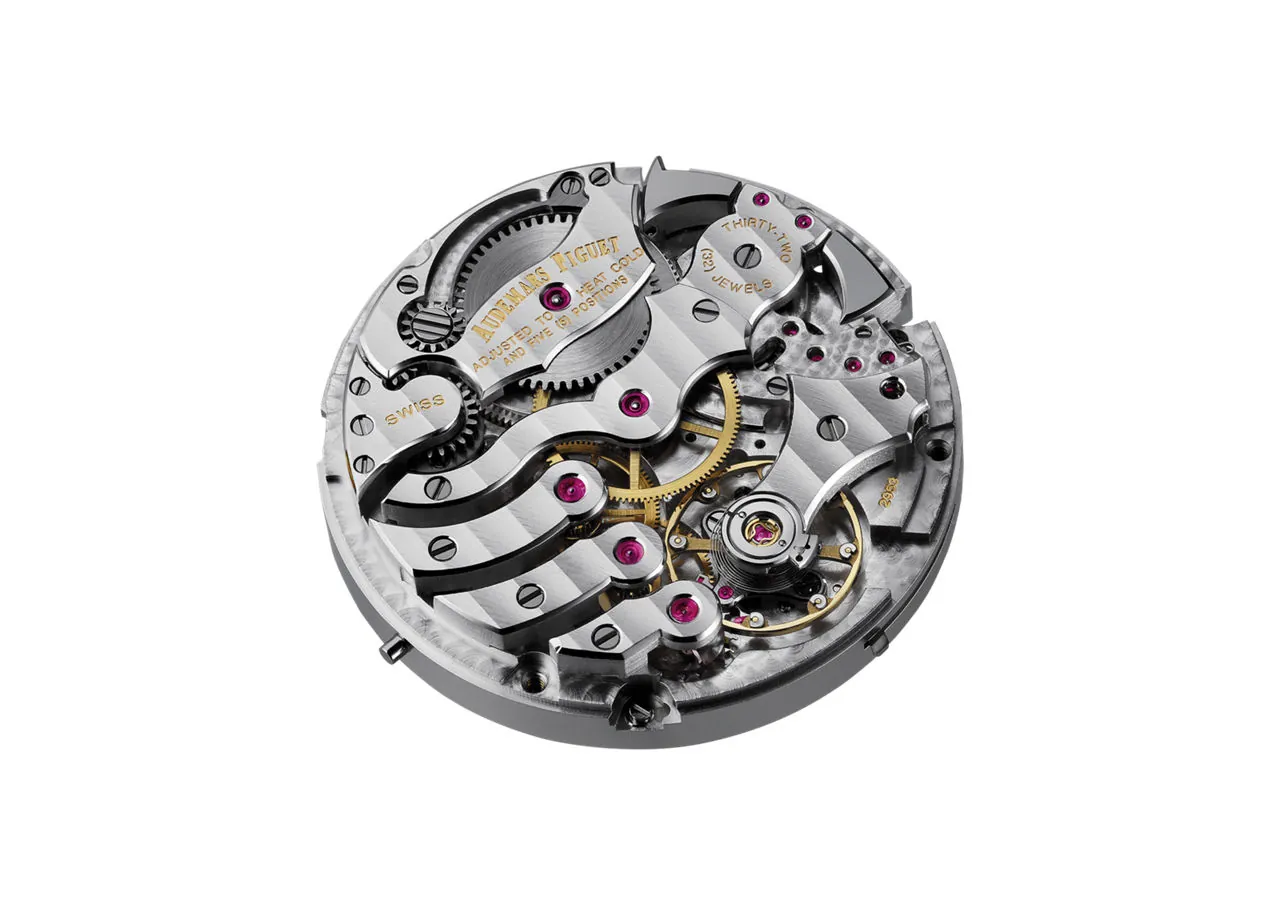
The system has a long development history behind it. It grew out of an eight-year programme that brought together watchmakers, musicians and acoustic researchers from the Swiss Federal Institute of Technology in Lausanne, and it first reached a production watch in the Royal Oak Concept Supersonnerie of 2016. The calibre 2953 arrived in 2019 as the production form of that research: 362 components, 32 jewels, a frequency of 3 Hz (21,600 vibrations per hour) and a power reserve of 72 hours, in a movement 30 mm across and 6 mm thick. It drives hours, minutes and a small seconds at six o'clock, and the repeater on demand.
Titanium and green smoke
The titanium Royal Oak, reference 26591TI. OO.1252TI.08, is the reference the manufacture leads with. The case is 42 mm across and 14 mm thick, entirely in titanium, with an integrated titanium bracelet and AP folding clasp, and water resistance of 20 metres. Its dial abandons the Grande Tapisserie pattern the Royal Oak is known for: a smoked green sunburst finish that darkens towards the edge, a tone-on-tone small seconds counter in green, hour markers in rhodium-toned 18-carat pink gold and hands in 18-carat white gold, both filled with luminescent material. The effect, judged from the manufacture's specifications and photography, is a chiming watch that reads as a sports watch first and a grande complication second.

Pink gold, a first for the line
The second Royal Oak, reference 26591OR. OO.1252OR.01, is the first pink gold model in the Royal Oak Minute Repeater Supersonnerie line. It keeps the Grande Tapisserie dial, in brown, with a brown small seconds counter and pink gold hands and hour markers, on a matching pink gold integrated bracelet. Same case dimensions, same calibre, a very different register: where the titanium watch underplays the complication, the gold one dresses it. Between them, the pair covers the two audiences for a modern repeater, the collector who wants the mechanism without the ceremony and the one who wants both.
The Code 11.59 takes the sapphire route
The third watch, reference 26395BC. OO. D009CR.01, puts the calibre in a 41 mm white gold Code 11.59 case, 13.6 mm thick, behind a smoked sapphire dial that leaves the chiming mechanism partly visible. It is the most technical-looking of the three and the least expensive, which in this company is a relative term. Swiss list prices are CHF 325,000 for the Code 11.59, CHF 351,100 for the titanium Royal Oak and CHF 391,400 for the pink gold Royal Oak. Sales are through Audemars Piguet's own boutiques and AP Houses. The repeater trio arrived alongside two 38 mm Code 11.59 Selfwinding models with natural stone dials, in gold obsidian and black onyx, powered by the calibre 5909.
Two practical details deserve noting. All three watches are water resistant to only 20 metres, a figure that looks low beside the Royal Oak's sports watch image but reflects the repeater's slide and seals: a chiming watch is an instrument to be kept dry, whatever case it wears. And the Royal Oaks carry the complication in a 14 mm case, thick by the line's standards, because the soundboard architecture needs volume to work in. The manufacture has consistently chosen audibility over slimness in this line, and these references continue that trade without apology.
On the evidence of the specifications and the manufacture's own published material alone, the trio is a consolidation rather than a reinvention: a proven calibre, a proven acoustic idea, and three case and dial combinations that had not previously existed in the line. That is arguably the right move for a minute repeater in 2026. The Supersonnerie's claim was never novelty for its own sake; it was that a repeater should be heard properly. Ten years on, Audemars Piguet is still building watches around that single acoustic argument, and the argument has not got weaker.