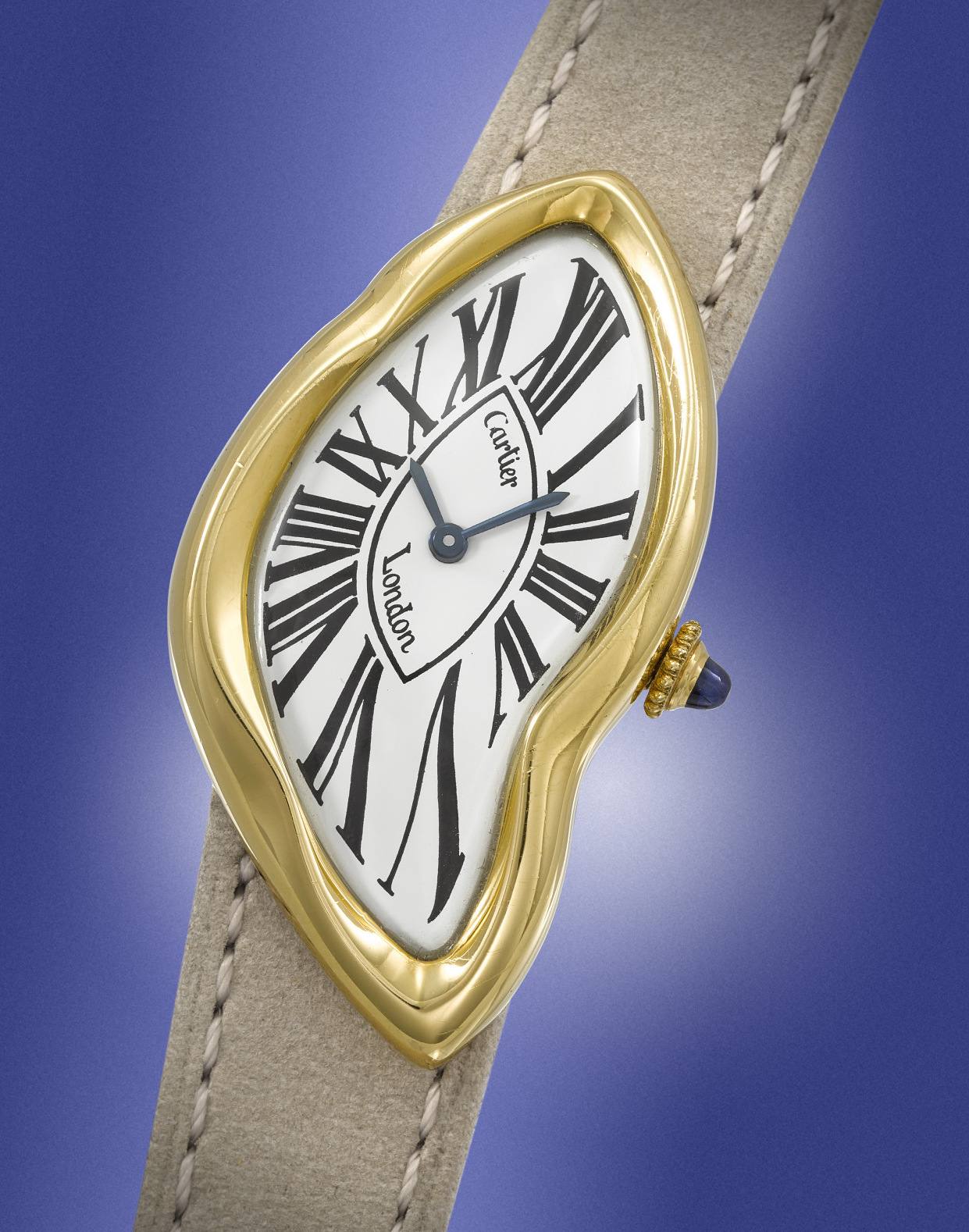
The Crash is the least Cartier-like watch Cartier ever made, which is precisely why collectors cannot stop thinking about it. It appeared in London in 1967, during the years Jacques Cartier ran the maison's London branch, an asymmetric case that looks as though a conventional oval watch has been stretched and twisted by centrifugal force. The dial follows the case: Roman numerals bent along the distorted oval, hands to match. Nothing about it is symmetrical, and nothing about it has ever been repeated by anyone else.
The famous origin story, that the design was inspired by a Cartier Baignoire melted in a car fire and brought back to the boutique, is repeated in every telling and confirmed in none. Francesca Cartier Brickell's 2019 book, drawn from the family archives, instead attributes the design to Jean-Jacques Cartier working with designer Rupert Emmerson, reinterpreting the elegant Maxi Oval for the psychedelic age. What is documented is the London manufacture: early Crash watches carry Cartier London signatures, and the 1990s London-made pieces bear the 'JC' mark of Jacques Cartier alongside London hallmarks. The London connection matters because the Crash is a Swinging London object, a product of the same moment that produced the mini skirt and the album cover as art form, and it could not have come from Paris or New York.
Production was always tiny, which is why the model spent decades as a connoisseur's footnote rather than a market force. Cartier has reissued it only rarely, and each reissue has been absorbed instantly by a collector base that has grown steadily while supply has not. That long, slow appreciation curve is the classic shape of a cult reference: ignored, then noticed, then chased.

The chase reached its current peak in May 2026, when Christie's Geneva sold a 1990 18k gold London Crash, complete with its original Crash deployant clasp, for CHF 1,585,000 (US$2,028,800), tripling its low estimate and setting a new world auction record for the model. It reclaimed a record Sotheby's had set for the model only two weeks before, which tells you how fast the bidding logic is moving: two houses, two records, fourteen days.
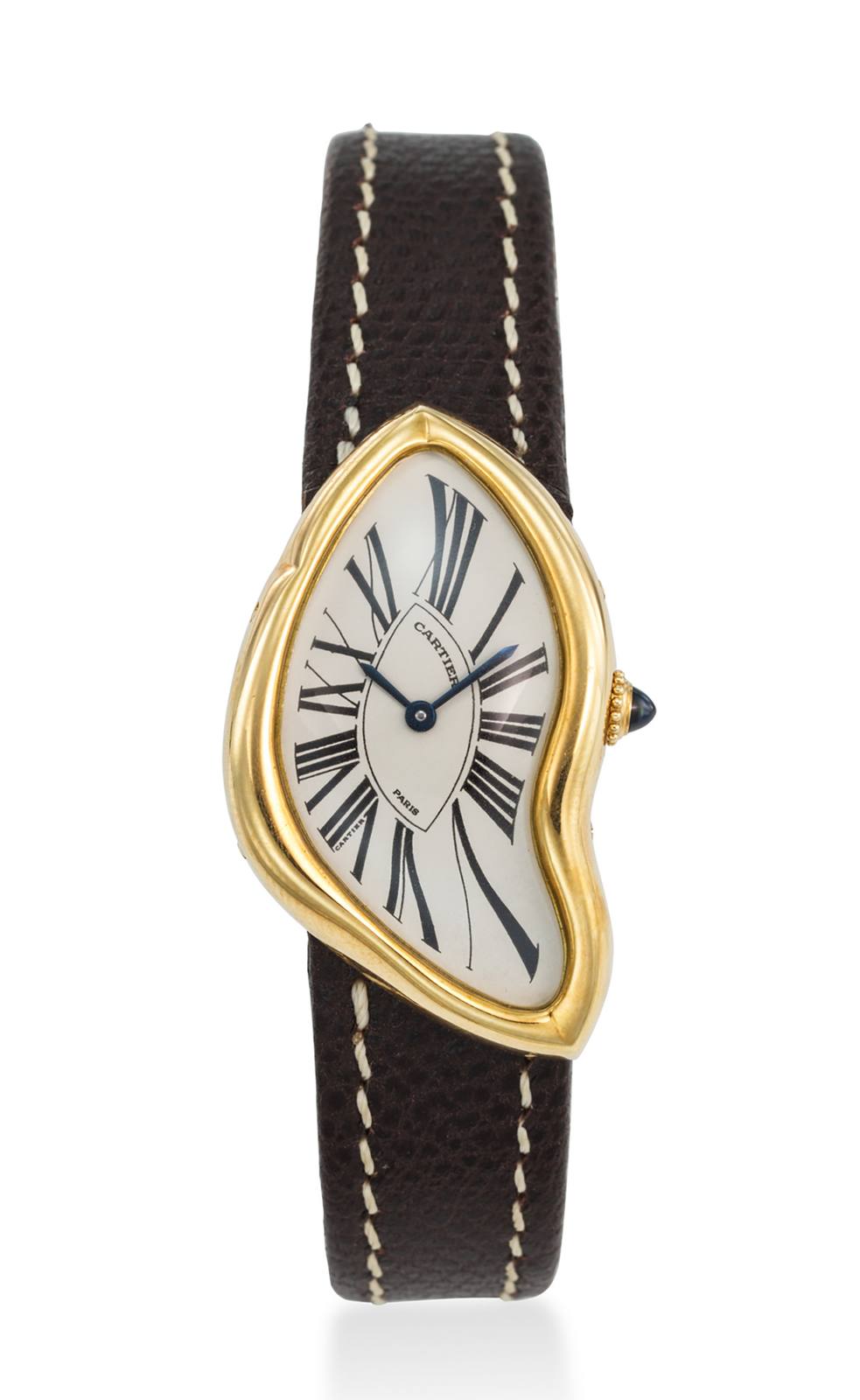
It is worth noting how alone the Crash stands. Watchmaking has produced very few genuinely asymmetric cases, and none that survived. The design world is full of objects that bent the rules once and became icons for it, and the Crash belongs in that company: a watch that ignored every convention of its craft and was proven right by time. Its reissues, always small and always quickly absorbed, have only confirmed the original's status.

The Crash's rise says something about how taste moves in vintage collecting. For years the market rewarded the canonical: the sports chronograph, the dress watch, the tool watch. The Crash rewards none of those categories. It is a design object first and a timekeeper second, closer to a piece of sculpture that happens to tell the time. Its ascent suggests collectors are increasingly buying the idea of a watch, its strangeness, its story, its London provenance, as much as the watch itself. In a market that now prices certainty above all, the Crash offers a different certainty: that nothing else looks like it, and nothing else ever will.